Over the past 10-15 years at De Smet Jesuit in Saint Louis, MO, our traditional classrooms have shifted from teacher-centered, lecture-based models to a school where students are active, engaged, collaborative, and hands-on.
De Smet Jesuit began using the Cognia Effective Learning Environments Observation Tool® (eleot®), comprehensively two years ago, as part of our Cognia Accreditation work, and it invited us to identify where students are engaged in classrooms and what we can do to continuously improve student engagement. The tool helps us to understand how individual teachers and the school at large compare to network averages in student learning environments.
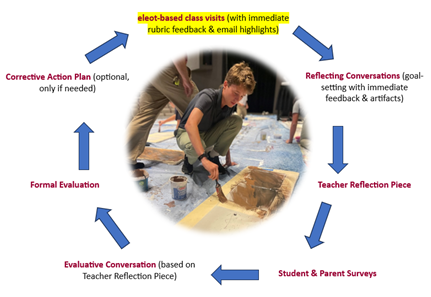 In the beginning, we were not interested in changing our classroom visit criteria, but we came to realize that the eleot is research-based and fits nicely into our current Growth Renewal and Evaluation (GRE) Process, as one of many components of this cycle where teachers are invited to see their classrooms, reflect on student experiences, set goals, and track growth.
Each teacher is visited three times per academic year and has three immediate, post-visit, 20-minute Cognitive Coaching Reflecting Conversations that invite the teacher to debrief the class. The visit and the eleot rubric feedback are a “jumping off platform” for diving deeper into teaching and learning through teacher conversation and reflection.
Some of the results of Cognitive Coaching Reflecting Conversation process are highlighted in a recent Source article, Encouraging Teacher Self Efficacy.
Our eleot Results
Cognia effectively collects and compiles school eleot data and presents it back to us. For example, last year our overall school score was 3.14, contrasted with the network average of 2.75. This overall score represents the average scores of all class visit rubrics submitted. And, for us, this score is cause for celebration.
The graph on the Cognia resource page illustrates that our school classrooms have four strengths – where evidence shows student engagement in these four eleot Learning Environments is higher than the network average:
- Students are learning in classrooms where we set high expectations
- Students are supported in their learning
- Students learn in classes that are well-managed
- Students are in classes where digital learning takes place
From the data, we also identified three areas for growth, where students fall below the network average in three eleot Learning Environments: Equitable Learning, Active Learning, and Progress Monitoring.
Increasing Awareness
We have worked to strengthen our practice in the areas highlighted by the eleot Learning Environments where we are below the network average through a campaign of awareness, resourcing, and celebrating. This academic year is one of awareness. We institutionalized awareness by identifying four eleot Learning Environments where student engagement is strong and noting three eleot Learning Environments where we want to increase student engagement.
We institutionalized awareness by identifying four eleot Learning Environments where student engagement is strong and noting three eleot Learning Environments where we want to increase student engagement.
First, we did this with a stipend-based, in-house department chair seminar in August 2025, where we reviewed the eleot data from our previous 2024-2025 academic year. The seminar not only raised awareness but also invited academic leaders to educate themselves on where these environments play out in our classes. Second, we identified areas for teacher growth in our classrooms: clearly communicating at the beginning of the school year and publishing the three areas in written documents, such as the weekly Principal’s Newsletter. Third, we increased awareness through a series of PD seminars focused on our three areas for growth, based on data from last year.
Awareness pays off. After a PD day, a seventh-grade math teacher invited me to visit a class where she was “pretty sure” student progress monitoring was taking place. I accepted her invitation, visited the class, and sure enough, I saw student progress monitoring (her eleot score was 3.79 on the 4.0 scale). On the eleot rubric and in a follow-up email, I wrote:
You invited students to do independent work, then pivoted to a class conversation around their responses. This was an opportunity for students to progress monitor as they answered your questions, responded to one another, and engaged with what was written on the Smartboard. Students also worked in pairs, with continuous progress monitoring from peers and you (as you walked around).
In a follow-up Cognitive Coaching Reflecting Conversation, the teacher referenced a low eleot score in the Equitable Learning Environment. While I reminded her that a mark of “1” in a sub-division or category of an eleot Learning Environment does not necessarily represent a low score – that it could represent “I did not see it;” nonetheless, she replied to me, “You won’t see [differentiation] in my class, because it is an advanced class, and everyone is [supposed to be] achieving at high levels.”
As the conversation continued, she reflected on a pairing activity in her class, in which she gave students the option to work alone or in pairs. I pointed out that, while not readily apparent in the class I visited, this is an example of differentiation within eleot’s Equitable Learning Environment. We had something to celebrate.
Finally, at the end of the Cognitive Coaching Reflecting Conversation, I asked, “How has this 20-minute Reflecting Conversation helped you?” She replied, “I wasn’t aware that I even differentiated until it came up in this conversation.” Hopefully, the awareness we cultivated during our conversation spills over into her classroom.
Developing Resources
Over the summer, we developed a school-specific eleot Resource for faculty that includes:
- A simple data analysis including awareness of four areas of eleot Learning Environment success and three areas for eleot Learning Environment growth based on our data from last year, 24-25.
- Definitions of high-functioning classrooms in our school, with 14 summative qualities from direct observations.
- Information about low eleot-scoring classrooms, with general qualities from direct classroom observations. Here, no specifics are identified, even though we use examples from direct observations in general terms.
- Classroom qualities aligned to our three eleot Learning Environment areas for growth from our school classrooms, to share with colleagues so they can see where these three eleot Learning Environments are already playing out.
- An audit and cursory research links for our three eleot areas for growth.
Professional development is tied to our School Improvement Plan (SIP). One of our SIP goals is increasing research-based best practices for block learning and teaching.
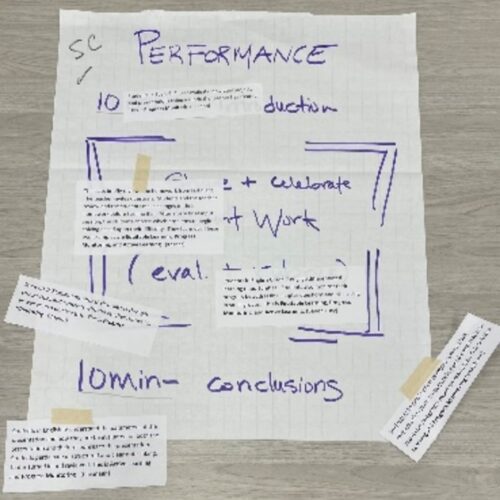 During our PD days this year, as a follow-up to inviting teachers to identify what a typical block class looks like in their specific classrooms, we show teachers concrete examples of how their colleagues’ students engage in Equitable Learning, Active Learning, and Progress Monitoring. After showing teachers these examples, we invite them to overlay the examples onto existing block frameworks, as presented in Making the Most of a 90-Minute Block (Gonzales).
In October, most of the eleot examples of these Learning Environments were placed onto the block framework labeled “performance.” Coincidentally, this type of block class at our school also yields the highest eleot scores. Participants, by their own decisions to place the concrete examples there, illustrated this point. This exercise offers us the opportunity to see where the highest-functioning classes, according to the eleot data, happen in our school, as well as reflect on how we can leverage the best practices from these classes.
Through PD days, we resource teachers in practical, real ways. Increased awareness of these classroom best practices increases the frequency with which students are engaged in these effective Learning Environments.
A recent data snapshot, shown below, taken in October 2025 and March 2026, invites us to see how we have grown this year. All our scores in these three Learning Environments have improved, which is a cause for celebration.
| May 2025 | October 2025 | March 2026 | Network Average to Date | |
| Overall Score | 3.14 | 3.2 | 4.61 | |
| Equitable Learning | 3.23 | 3.27 | 3.32 | 3.33 |
| Active Learning | 2.95 | 3.02 | 3.15 | 3.15 |
| Progress Monitoring | 2.64 | 2.77 | 2.92 | 3.1 |
Celebrating Success
At my school, when we see success, we celebrate success. So, this fall, during class visits where we use eleot and see Equitable Learning, Active Learning, and Progress Monitoring, we not only call it out on the rubric and in our post-visit emails to teachers but also honor classes and students with eleot Excellence Class awards. We congratulate award recipients in our weekly Principal Newsletter. To date, we have awarded 23 eleot Excellence Class awards, and we encourage teachers to hang the awards in their classes as a reminder of student success and excellence.
We plan to strengthen and increase the frequency of successful implementation of all Learning Environments, particularly those where we are below the network average, by continuing to raise awareness, provide insights and resources to teachers, and celebrate successes in our classrooms.

© Cognia Inc.
This article may be republished or reproduced in accordance with The Source Copyright Policy.
The information in this article is given to the reader with the understanding that neither the author nor Cognia is in engaged in rendering any legal or business advice to the user or general public. The views, thoughts, and opinions expressed in this article belong solely to the author(s), and do not necessarily reflect the official policy or position of Cognia, the author’s employer, organization, or other group or individual.
