A real and urgent goal in education today is to improve the ways we teach Science, Technology, Engineering, and Mathematics (STEM) in our schools. This urgency comes from the growing belief among business, policy, and education leaders that expanding STEM education “can lead to productive employment and is critical to the nation’s innovation capacity” (National Research Council, 2014).
An effective STEM program goes beyond offering high-quality classes in STEM disciplines. It involves engaging students in interdisciplinary, integrated STEM and inquiry learning experiences.
Research shows that early exposure to STEM, particularly before age eight, can significantly impact academic success and support learning in other areas, such as reading and language development (Movahedazarhouligh et al., 2023). This highlights the importance of integrating STEM not only across disciplines but also across grade levels.
The best approach to implementing effective STEM programs depends heavily on a school’s local context, community, and available resources. Many institutions pursue certifications, such as Cognia STEM Certification, to assess and improve their programs. These certifications offer a structured way for schools to reflect on their practices and identify opportunities for continuous improvement.
[STEM] certifications offer a structured way for schools to reflect on their practices and identify opportunities for continuous improvement.
To explore what effective STEM learning looks like in practice, we spoke with two Virginia institutions that are leading the way in providing engaging, integrated STEM experiences: Kecoughtan High School and the Northern Virginia Science Center.
Kecoughtan High School: Career Focused STEM Engagement
Located in Hampton, Virginia, Kecoughtan High School began its partnership with Cognia in 2013 through Cognia Accreditation. In 2024, they earned Cognia STEM Certification to evaluate and strengthen their STEM education program.
We spoke with Dr. Lucas, principal of Kecoughtan High School, about their approach to STEM learning. The school uses a model centered on innovative, career-focused “academies,” including their STEM-focused academy, the Governor’s Academy of Architecture, Environment, and Engineering (AAEE). Through industry and community partnerships, these academies allow students to engage in learning related to their interests and expand their knowledge with real-world applications.
Dr. Lucas emphasized the school’s focus on project-based learning where students tackle real-world challenges often tied to their Career and Technical Education (CTE) courses. These projects “always have interdisciplinary pieces to them where they integrate STEM.”
One standout example is the school’s agriculture pathway, where students gain hands-on experience in the industry and really learn about plant life. This learning not only connects to specific units in their science class, but it also allows students to view the topic from a business lens and integrate English Language Arts through writing product summaries.
Integrating STEM happens not only horizontally within the same grade levels, but also vertically to ensure continuity and growth between grade levels. The Hampton City Schools district has developed a “Portrait of a Hampton Graduate” outlining the skills students should build from elementary through high school. The district has also developed a profile of an elementary scholar and a middle school scholar to ensure those core competencies and skills are being captured and worked towards throughout a students’ educational journey, not just in high school. This helps to facilitate vertical and horizontal collaboration and communication, which is so essential to all learning, not just in STEM.
When we look at student performance and success in high school, it’s not just about the high school teachers. It’s about the continuum of pre-K to graduation and how we’ve served students over the years.
“When we look at student performance and success in high school, it’s not just about the high school teachers. It’s about the continuum of pre-K to graduation and how we’ve served students over the years,” shared Dr. Lucas, “There is a lot of vertical and horizontal articulation happening to make sure we build upon strengths and find opportunities for improvement to prepare our students for what comes next.”
With their programs, Kecoughtan has seen an “increase in student engagement” and Dr. Lucas also shared that “on-time graduation rate ultimately increases.” Even beyond the classroom, they have seen engagement in student organizations and extracurricular activities, many of which integrate STEM concepts, that allow them to reinforce their learning and apply their knowledge.
Dr. Lucas encourages other schools to consider STEM certification to support the effectiveness of their STEM programs as well. He expressed that “The process and the tools really lend themselves to helping you determine where you are to guide you to where you should be.”
Northern Virginia Science Center: Inspiring STEM Learners
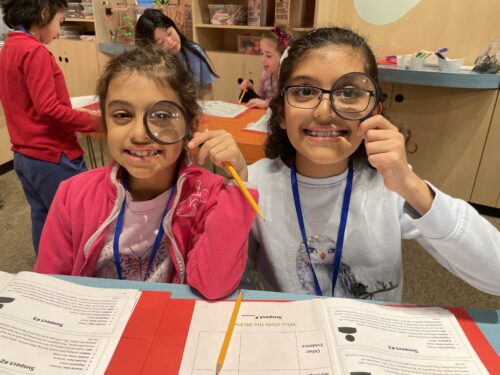
Although the permanent facility is still under development, the center is already serving the community through a temporary location, the Children’s Science Center Lab, offering STEM programming that will expand significantly once the new space opens. The center’s mission is to inspire a lifelong love of STEM learning and provide pathways and opportunities for children and youth to explore and expand their interest in STEM.
We also spoke with Nene Spivy, the CEO of the Northern Virginia Science Center Foundation. Their new science center is now under construction and being developed through a partnership between the Science Museum of Virginia, and Loudoun County.
Like Dr. Lucas, Nene Spivy emphasized the importance of STEM learning early in life to set students up for success. She shared, “Having those experiences early on is foundational. We really want to make sure that as many kids as possible see STEM as a pathway and take advantage of it.”
The center is committed to reducing barriers to STEM learning, especially for students who may not see STEM as “for them.” In addition to museum visits and field trips, the center offers internships, a youth advisory board, elementary school-based family science nights, and other after-school programs to extend learning beyond the K-12 classroom.
Spivy shared, “Through strategic partnerships, we’re building a statewide network of science museums and STEM learning in Virginia that we know is going to translate to big outcomes for the entire state. Shared resources and collaboration across the state in the name of STEM is pretty powerful.”
A Model for STEM Excellence
Kecoughtan High School and the Northern Virginia Science Center are just two examples of how Virginia institutions are leading the way in STEM education. Others, like The Goddard School and Activ8 STEM Academy in Danville, are also partnering with Cognia to support their STEM programs.
The Goddard School, an early learning franchise system, leverages inquiry-based learning to integrate STEM learning throughout the curriculum. Activ8 STEM Academy, serving students in grades three through six, takes a truly interdisciplinary and integrated approach to STEM to provide deep learning experiences.
Through community partnership, project-based learning, interdisciplinary integration, and early exposure to STEM, these institutions are providing meaningful STEM learning and developing skills to prepare students for the future. As Dr. Lucas put it: “[STEM learning] is about more than just computer skills or science knowledge, it is about how are we improving our way of life and the way that we’re doing things for others.”
[STEM learning] is about more than just computer skills or science knowledge, it is about how are we improving our way of life and the way that we’re doing things for others.
To learn more about Cognia STEM Certification, visit: https://www.cognia.org/stem-certification/
References
Hairston, A., James, J., Middleton, K. A., Murray, N., & Simmons, D. (2025). Different paths,same vision: four models for cross-curricular stem integration. STEM Magazine.
Kecoughtan High School. (2025). https://khs.hampton.k12.va.us/
Movahedazarhouligh, S., Kermani, H., Aldemir, J. (2023). STEM Integrated Curriculums in Early Childhood Education: An Exploration of Teachers’ Pedagogical Beliefs and Practices. International Journal of Modern Education Studies, 7(2),106-127. https://doi.org/10.51383/ijonmes.2022.266
National Research Council. (2014). STEM Integration in K-12 Education: Status, Prospects, and an Agenda for Research. Washington, DC: The National Academies Press. https://doi.org/10.17226/18612.
Northern Virginia Science Center. (2025). https://www.novasci.org/

© Cognia Inc.
This article may be republished or reproduced in accordance with The Source Copyright Policy.
The information in this article is given to the reader with the understanding that neither the author nor Cognia is in engaged in rendering any legal or business advice to the user or general public. The views, thoughts, and opinions expressed in this article belong solely to the author(s), and do not necessarily reflect the official policy or position of Cognia, the author’s employer, organization, or other group or individual.
