Each year, Cognia publishes an Impact Report that celebrates our shared achievements with the Cognia global network of schools, systems, states, and educational organizations.
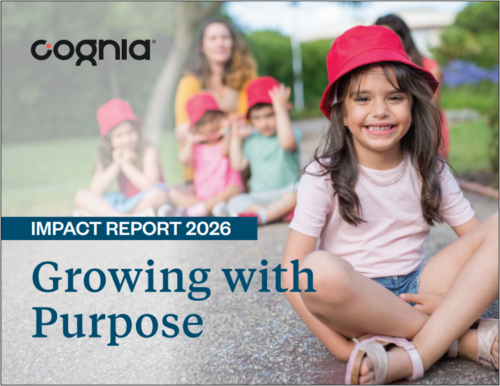
Cognia’s 2026 Impact Report, released in October, recognizes new milestones from the 2025-2026 school year. The report highlights Cognia and our network’s expansion and growth this past year in pursuit of our shared mission to improve student learning outcomes. This expansion has taken the form of new and improved processes, offerings, and partnerships to enhance how we support leaders, educators, and students every day. For a summary of some of these achievements, explore the summarized key highlights below.
We look forward to even greater strides in our capability to support your growth and improvement in the coming year.
Key Highlights
| Cognia continues to have an impact around the globe. | In 2026, Cognia was a trusted partner for school improvement to 17 million students and 800,000 educators across 40,000 public and private institutions in 91 countries. |
| Cognia introduces new accreditation statuses for transparency and clarity in accreditation. | Cognia introduced new accreditation statuses and a new standard focused on student performance to promote transparency and clarity in the accreditation process.
Institutions can earn the status of “Accredited with Distinction,” “Accredited with Merit,” “Accredited,” or “Accredited Needing Improvement” based on the results of their Engagement Review. The new standard considers student performance and growth based on valid assessments. |
| Accreditation data reveals perception gaps. | Cognia analyzed accreditation surveys from 906 schools across 39 states, yielding 39,291 educator responses and 78,757 family responses to understand how perceptions about school differed and aligned among educators, families, and students.
The analysis found strong alignment in perspectives around school culture and gaps in learner-centered instructional practices. We uncovered patterns based on demographics, providing insight into where schools might bridge gaps in understanding through improved communication |
| Partnership with KaiPod Learning expands access to accreditation for microschools. | Cognia partnered with KaiPod Learning, a startup that supports the launch and operation of microschools, to provide microschools an opportunity to achieve “synchronized” accreditation. As part of this collaboration, we developed a new framework for accrediting microschools, tailored to their unique structure. |
| Cognia introduces new board governance certification and American school certification. | In the 2025-2026 school year, we launched two new certifications: Cognia Board Governance Certification and Cognia American School Certification. These certifications provide institutions with a thorough third-party evaluation that recognizes their effectiveness in their specific role within the education landscape and demonstrates their commitment to improvement. |
| STEM certification reveals strengths and opportunities for growth. | Colegio CIEDI is an International Baccalaureate Continuum school in Bogotá, Colombia, that serves 405 students with its rigorous iSTEM program. The school chose to pursue Cognia STEM Certification, becoming the first school in Bogotá and the second in Colombia to earn the certification.
Through this certification process, the school underwent a thorough review that highlighted the strengths of its program with its university partnerships and revealed new opportunities for growth with its protocols for analyzing STEM mastery. The school developed a strategic plan to improve after this process and used the Cognia Effective Learning Environments Observation Tool® (eleot®) to measure engagement and assess progress. |
| Observation data improves instructional practice. | Between 2025 and 2026, our observation tools were used for 244,695 observations.
De Smet Jesuit High School in Missouri began using the Cognia Effective Learning Environments Observation Tool® (eleot®) two years ago as part of their accreditation. They leveraged the tool as part of their teacher feedback and goal-setting process, using the data as a jumping-off point for conversations about instructional practice. In the 2025-2026 school year, they focused on developing more awareness of their areas for improvement and strengths to address them more directly. They did this through PD and targeted resources for educators. With their persistent focus on improvement, scores in the three Learning Environments where they saw opportunities for growth have improved. |
| Diagnostic reviews provide momentum for learning gains. | In the 2025-2026 school year, Cognia completed 77 diagnostic reviews for schools and districts.
One district that benefited from our diagnostic review process was Mandaree School District (MSD), a school system located in rural North Dakota that was identified for Comprehensive Support by the state. The district partnered with Cognia to help identify areas for improvement and make plans for systemic change. In just one year, students in grades K-2 exceeded the five-year proficiency goal in reading, jumping from 7% to 21% proficiency. |
| Cognia defines our vision for the future of assessment. | Cognia provides large-scale assessment solutions across 16 states, serving 7,288 institutions and 1.2M students. We also serve 17 districts and organizations with interim and formative assessment solutions, serving over 250,000 students.
Given the depth of our expertise and work in assessment across the country, we published “The Future of Assessment is Coherence” this year, which offers insights on how to build systems that are connected, transparent, more instructionally useful, and responsive to student needs. |
| The Cognia Strategic Thinking and Planning process leads to system growth. | Richmond County School System (RCSS) began using the Cognia Strategic Thinking and Planning framework to develop a data-driven improvement plan.
They were able to make immediate changes to how they operate, as well as plan larger improvements for the future, instituting “cross-functional walkthroughs” using eleot data that helped guide professional learning efforts. RCSS has now completed a second year of strategic planning, and the process has been well received by board members and leaders alike and is driving growth for the system. |
| Asynchronous professional learning provides quality training and support to leaders and educators. | During the 2025-2026 school year, Cognia engaged 66,863 educators in asynchronous professional learning opportunities, including training on assessments, accreditation, early learning, observation tools, and more. |
Read the full Cognia Impact Report

© Cognia Inc.
This article may be republished or reproduced in accordance with The Source Copyright Policy.
The information in this article is given to the reader with the understanding that neither the author nor Cognia is in engaged in rendering any legal or business advice to the user or general public. The views, thoughts, and opinions expressed in this article belong solely to the author(s), and do not necessarily reflect the official policy or position of Cognia, the author’s employer, organization, or other group or individual.
