Our recent research & insights paper, “Two Different Early Learning Settings: What They Reveal About Learning Quality,” challenges leaders to look beyond differences between school-based and standalone early learning programs and focus on a shared opportunity for growth.
Drawing on 3,872 classroom observations from 440 early learning programs, the study found that while program models demonstrated different strengths, both settings showed lower levels of open-ended questioning, child brainstorming and opportunities to make predictions, and the use of math and science tools during learning experiences.
For early learning leaders, this finding represents a great opportunity for improvement, as it appears across delivery models regardless of organizational structure. Research indicates that inquiry-rich learning environments help build the cognitive skills that underpin later academic success. When children are encouraged to make predictions, investigate questions, examine evidence, and explain their thinking, they strengthen reasoning, problem-solving, and executive function skills that support learning across content areas (Ramanathan et al., 2022).
Research indicates that inquiry-rich learning environments help build the cognitive skills that underpin later academic success.
The power of regular, focused observations
The findings regarding this gap in inquiry-rich learning emerged from observation data collected using Cognia’s Environmental Rating for Early Learning tool, a classroom observation tool designed to assess the quality of children’s day-to-day learning experiences by examining interactions, levels of engagement, classroom materials, and instructional support strategies. This tool captures evidence of what children and adults are actually doing during learning experiences.
Because this opportunity for growth appeared across delivery models, it suggests a broader instructional challenge rather than a structural one. The question for leaders becomes, “How do we consistently identify and strengthen these experiences in our classrooms?”
To address these instructional challenges, leaders need to commit to consistent observation and reflection, as what they observe informs what they can tangibly improve. Informal walkthroughs can provide snapshots, whereas a more consistent observation structure can reveal patterns in instruction and learning. Implementing scheduled structured observations allows leaders to move from making assumptions to gathering real evidence and analyzing trends across classrooms and grade levels to inform coaching and continuous improvement.
Research on inquiry-based learning suggests that children’s opportunities to predict, investigate, reason, and solve problems contribute to the development of scientific reasoning, critical thinking, and executive function skills (Ramanathan et al., 2022). When implemented regularly, targeted observations and feedback focused on specific skills and instructional practices allow leaders to identify not only isolated strengths or challenges but recurring patterns that can inform coaching, professional learning, and program improvement efforts.
When implemented regularly, targeted observations and feedback focused on specific skills and instructional practices allow leaders to identify not only isolated strengths or challenges but recurring patterns that can inform coaching, professional learning, and program improvement efforts.
Some of the questions we need to ask, and that Cognia’s Environmental Rating for Early Learning tool prompts us to reflect upon, when examining the evidence of children engaging in deeper thinking activities, include:
- Are children encouraged to predict outcomes?
- Are children solving problems and explaining their reasoning?
- Are math and science tools available and actively used?
- Are children sustained in meaningful exploration over time?
- Do educators create opportunities for investigation and discovery?
- Are teachers balancing guidance with child-led exploration?
Research suggests that opportunities to engage in these behaviors support the development of scientific reasoning, problem-solving, critical thinking, and executive function skills that contribute to later academic success. These practices help transform curiosity into deeper learning and are closely aligned with the areas highlighted in our research.
Leveraging Cognia improvement tools and STEM Certification in early learning
While observation is critical, leaders and teachers benefit from structured observations that focus on the practices most closely associated with deeper learning. Our tools provide a common language for discussing practice and delivering meaningful feedback to educators to support improvement efforts.
Frameworks such as our Environmental Rating for Early Learning tool and Early Learning STEM Observation tool can help school leaders structure their observations. These tools, available to all Cognia members as part of membership, provide specific indicators for inquiry, engagement, instructional support, investigation, and problem-solving.
[The Environmental Rating for Early Learning tool and Early Learning STEM Observation tool], available to all Cognia members as part of membership, provide specific indicators for inquiry, engagement, instructional support, investigation, and problem-solving.
The Environmental Rating for Early Learning tool has specific items that serve as indicators connected to inquiry: Open-ended questioning by adults, Children brainstorming and making predictions, and Children using math/science tools. The Early Learning STEM Observation tool is scored on a continuum and includes items related to investigation and discovery in its “Inquiry Domain.”
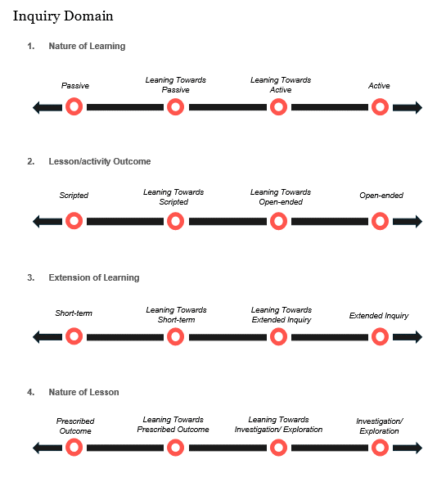
Early learning institutions seeking to even further evaluate and improve the effectiveness of their inquiry-based learning, specifically the integration of STEM concepts, can pursue Cognia STEM Certification.
The Goddard School®, a leading national early childhood education organization, provides an inquiry-based education program where STEM is woven into the entire curriculum. They pursued Cognia STEM Certification to further enhance their focus on inquiry.
Dr. Maria Shaheen, the Director of Education Research & Innovation at Goddard, shared their experience with the certification process:
As an organization that is always looking for better ways to help children learn, we pursued Cognia STEM Certification because we welcome an outside expert’s view to confirm the strength of our program and to help us take our programming to the next level of quality by examining areas we can continue to strengthen. The STEM certification process gave us an opportunity to take a close look at every part of our STEM work, including curriculum, professional development, research, stakeholder feedback, and student outcomes data. It also pushed us to think about how we can further optimize young children’s learning.
A key takeaway that they also shared from the process was a renewed focus on helping each Goddard School build meaningful STEM partnerships in its community, so that children’s learning reaches well beyond the classroom walls.
Deepening our commitment to early learning
Our research revealed a field-wide opportunity to strengthen children’s experiences with inquiry, prediction, and reasoning. Because these findings emerged from systematic observation data, they also demonstrate the value of regular, targeted observations as a leadership practice.
By using structured frameworks and processes such as the Environmental Rating for Early Learning, Cognia Early Learning STEM Observation Tool, and Cognia STEM Certification, leaders can move beyond assumptions and gain actionable evidence about both children’s learning behaviors and the adult practices that support them. Ultimately, observation and certification become more than measures of quality for early learning institutions; they become tools for continuous improvement and deeper learning.
References
Ramanathan, G., Carter, D. & Wenner, J. A Framework for Scientific Inquiry in Preschool. Early Childhood Educ J 50, 1263–1277 (2022). https://doi.org/10.1007/s10643-021-01259-1

© Cognia Inc.
This article may be republished or reproduced in accordance with The Source Copyright Policy.
The information in this article is given to the reader with the understanding that neither the author nor Cognia is in engaged in rendering any legal or business advice to the user or general public. The views, thoughts, and opinions expressed in this article belong solely to the author(s), and do not necessarily reflect the official policy or position of Cognia, the author’s employer, organization, or other group or individual.
